Dissecting the moat regime at low energies
Shi Yin (尹诗)
CPOD 2026, CERN
Based on:
1. Fabian Rennecke and SY, arXiv:2510.06712
2. Fabian Rennecke and SY, in preparation
3. Wei-jie Fu, Jan M. Pawlowski, Robert D. Pisarski, Fabian Rennecke, Rui Wen and SY, Phys.Rev.D 111 (2025) 9, 094026
2. Fabian Rennecke and SY, in preparation
3. Wei-jie Fu, Jan M. Pawlowski, Robert D. Pisarski, Fabian Rennecke, Rui Wen and SY, Phys.Rev.D 111 (2025) 9, 094026



Outline
- Moat regime on the QCD phase diagram
- Mechanism of the moat regime
- Connection to experimental observables
- Summary and Outlook
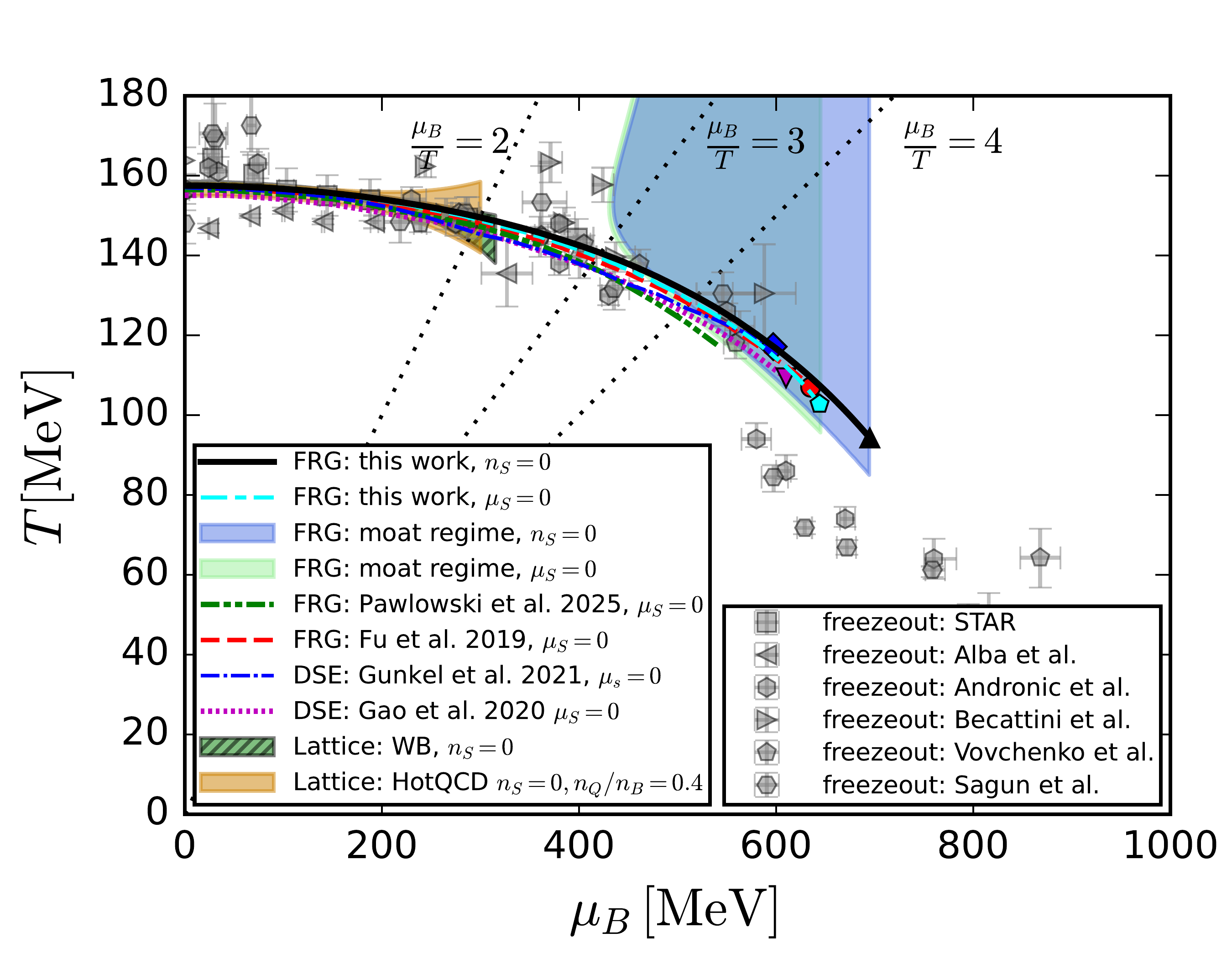
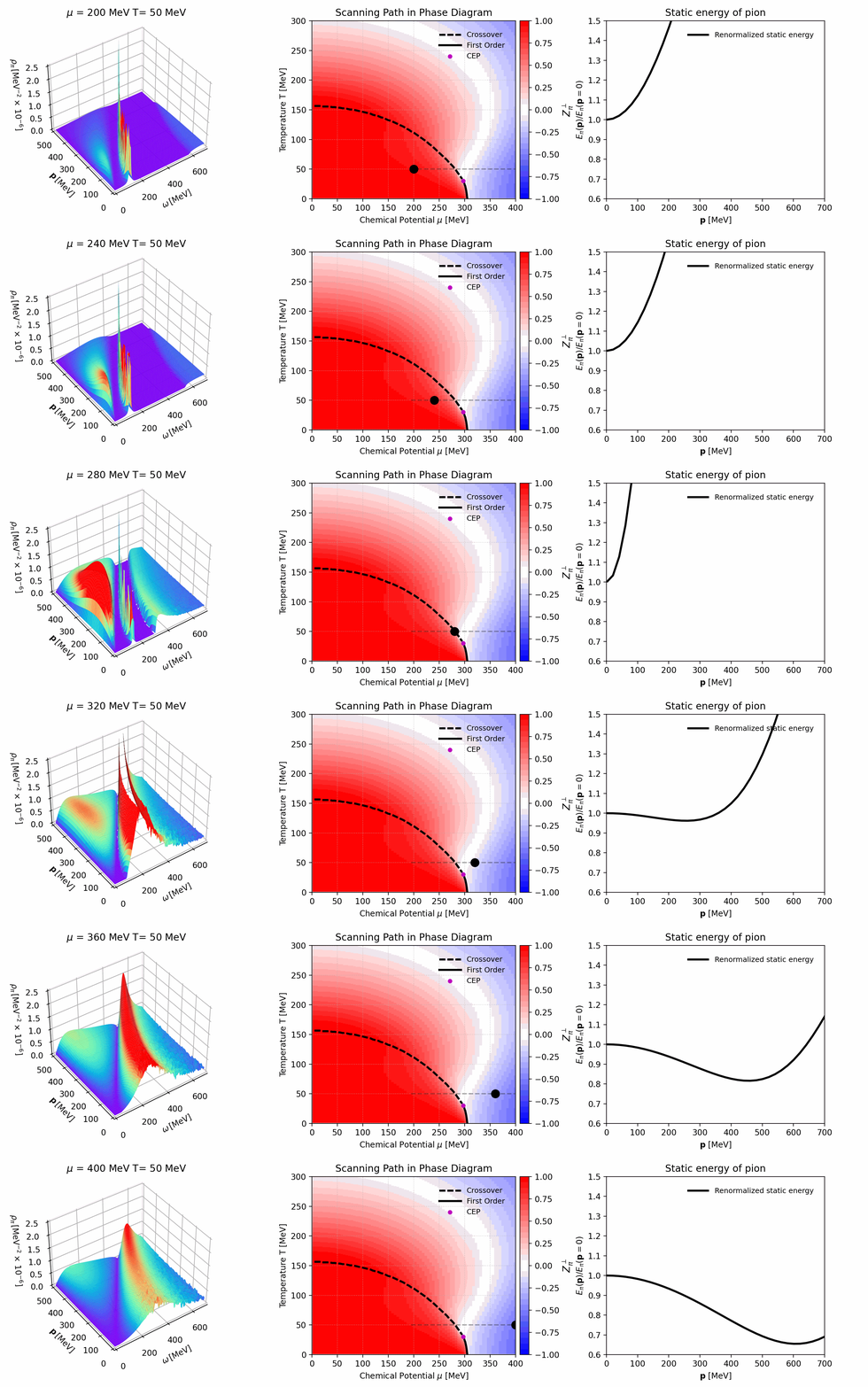
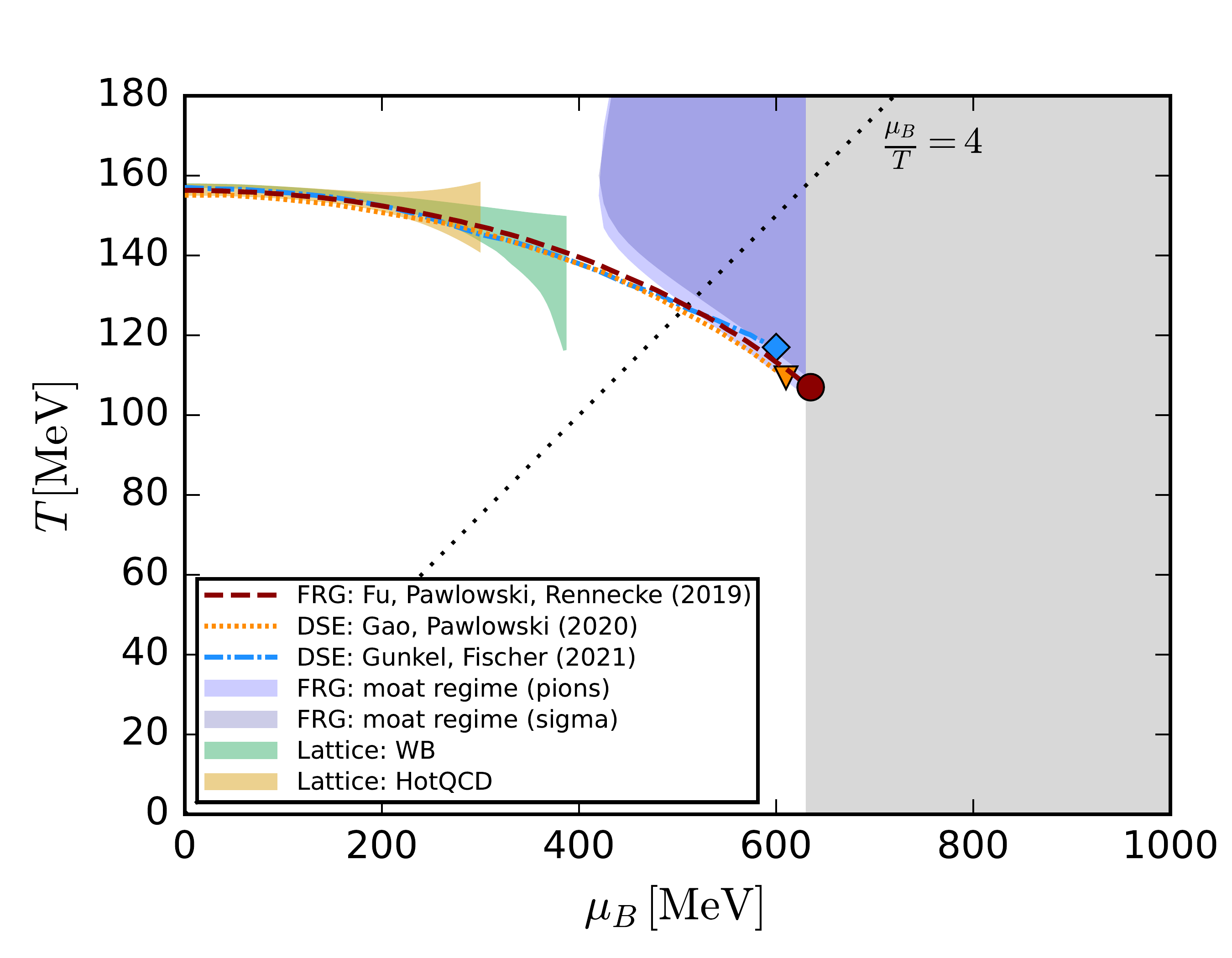
Moat regime on QCD phase diagram
not computed
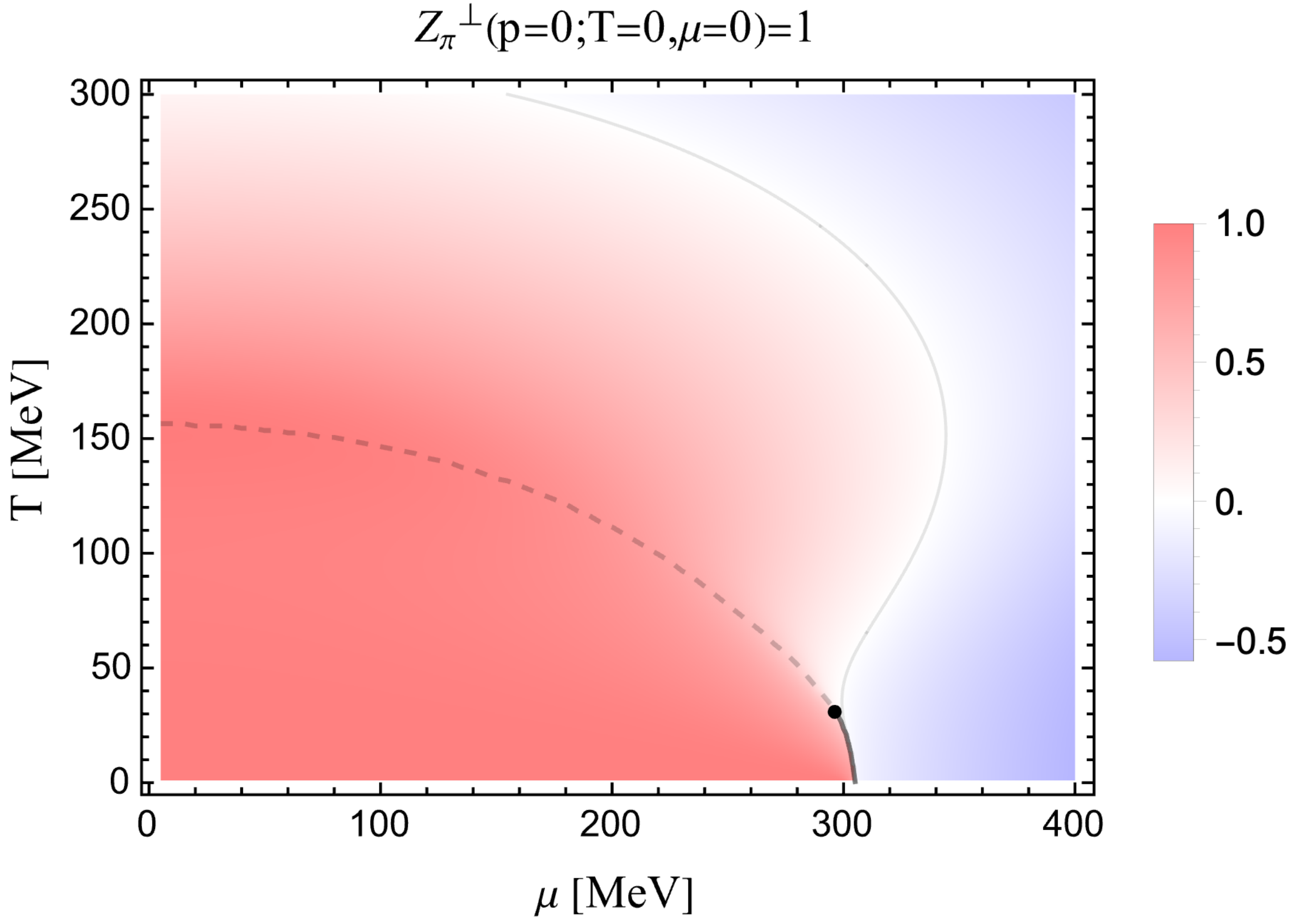
Zero-momentum approximation for matter sector
arXiv: 2603.13455
Static energy of pion
\[ E_\pi(\bold{p}) = \sqrt{Z^{\perp}_\pi\,\bold{p}^2 + m_{\pi}^2} \]
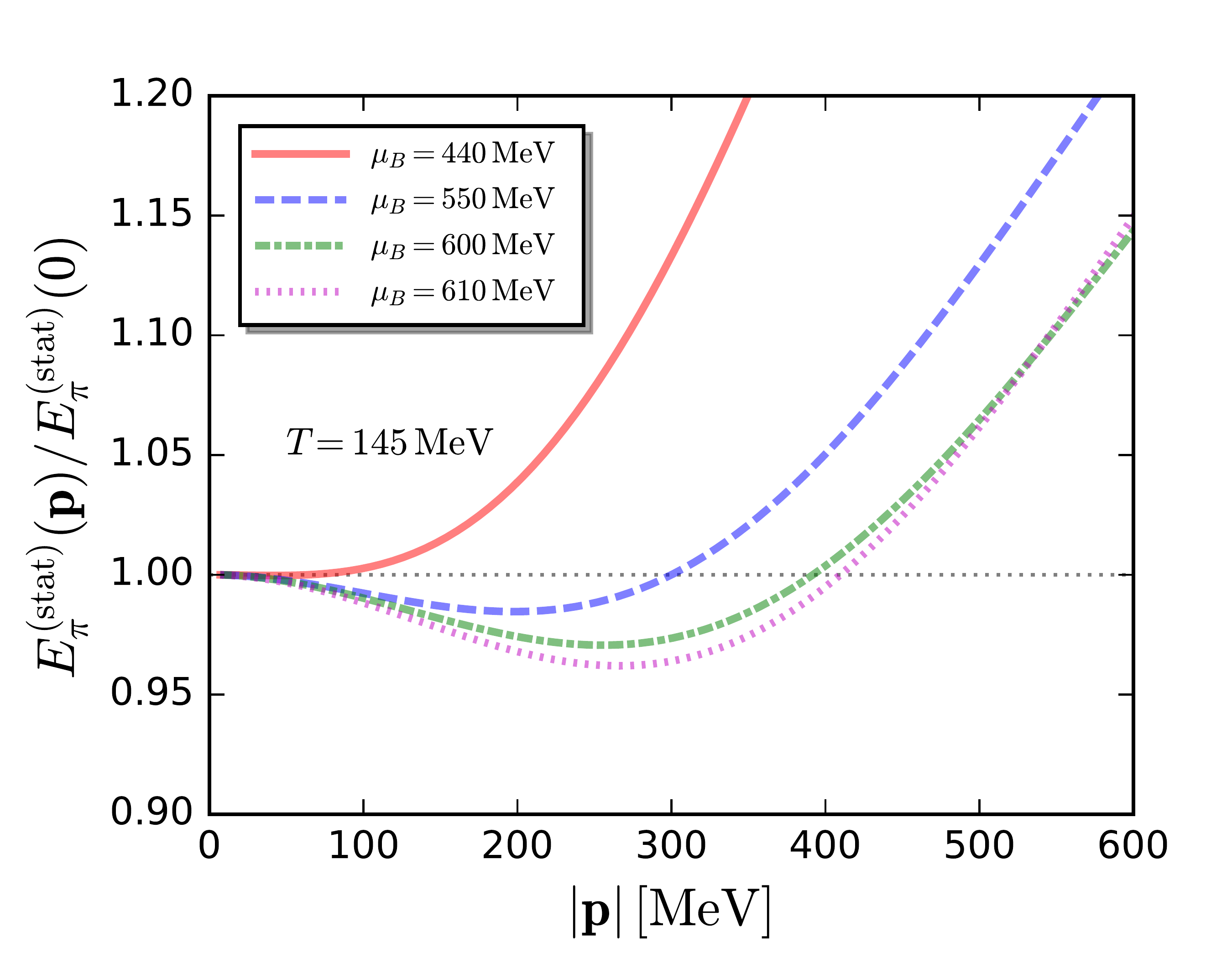
\[ Z^{\perp}_\pi(p=0)>0 \]
\[ Z^{\perp}_\pi(p=0)<0 \]
Moat regime on QCD phase diagram
Full-momentum dependent correlation functions
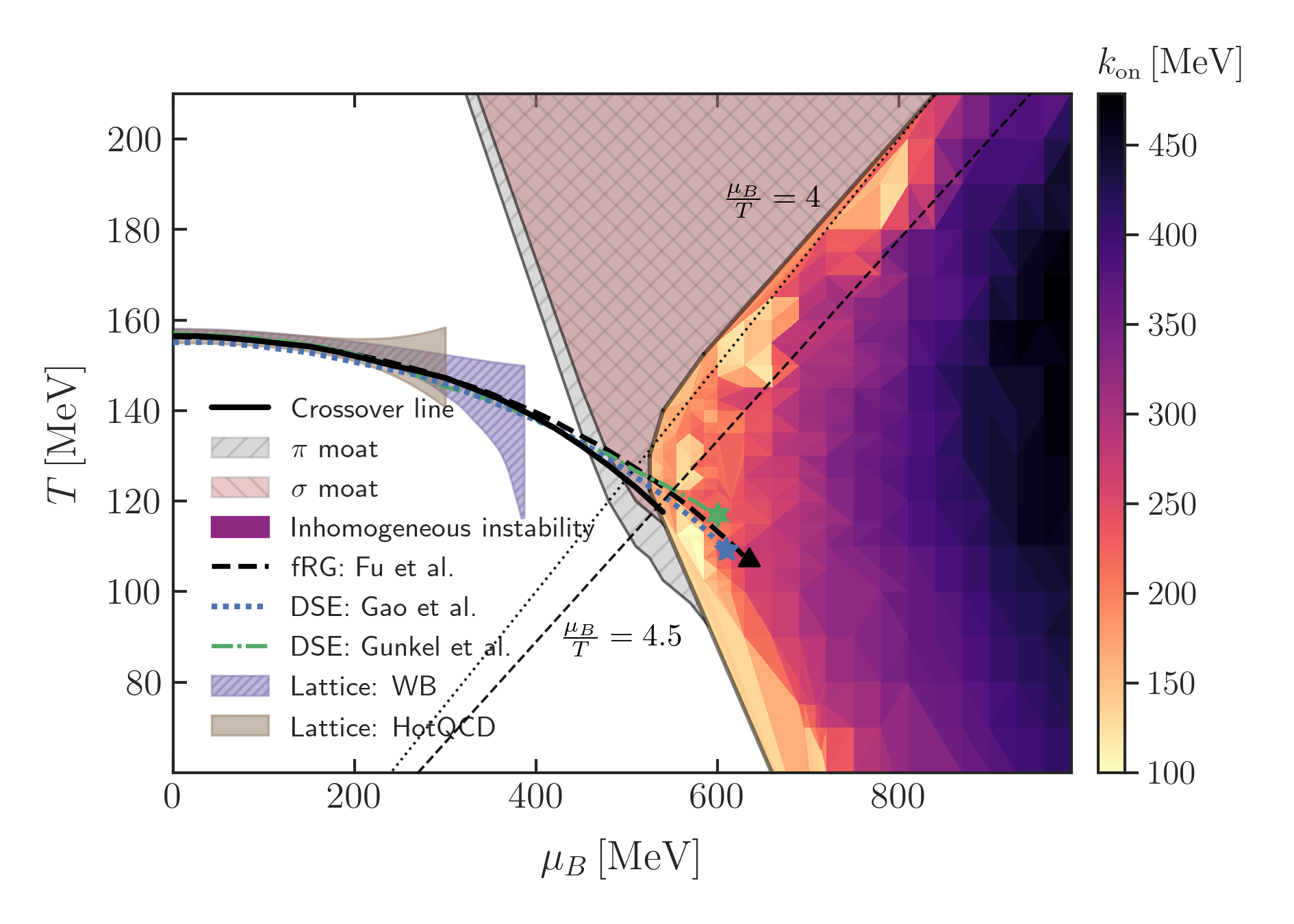
Moat
Inhomogeneous
See Franz's talk, tomorrow 15:00
Outline
- Moat regime on the QCD phase diagram
- Mechanism of the moat regime
- Connection to experimental observables
- Summary and Outlook
Mechanism of the moat regime
Quark-Meson model
\[
\begin{aligned}
\mathcal{L}[\phi,q,\bar{q}]&=\bar{q}\big[\gamma_\mu\partial_\mu-\gamma_0 \hat{\mu}\big]q+\frac{1}{2}\,(\partial_\mu\phi)^2\\[2ex]
&\quad+h\,\bar{q}(T^0\sigma+i\gamma_5\mathbf{T}\cdot\boldsymbol{\pi})q+U(\rho)-c\sigma\\[2ex]
&\quad+ \mathcal{L}_{\rm ct}\,.
\end{aligned}
\]
\[
\begin{aligned}
\Sigma_\pi(p^2;T,\mu)=p^2+m^2_\pi+\Pi^\pi_{\mathrm{RPA}}(p^2;T,\mu)
\end{aligned}
\]
\[
\begin{aligned}
Z^\perp_\pi(T,\mu)=\frac{\partial \Sigma_\pi(p^2;T,\mu)}{\partial \bold{p}^2}\bigg|_{p_0=0,\bold{p}=0}
\end{aligned}
\]

Moat regime in QM model
Mechanism of the moat regime
Self-energy
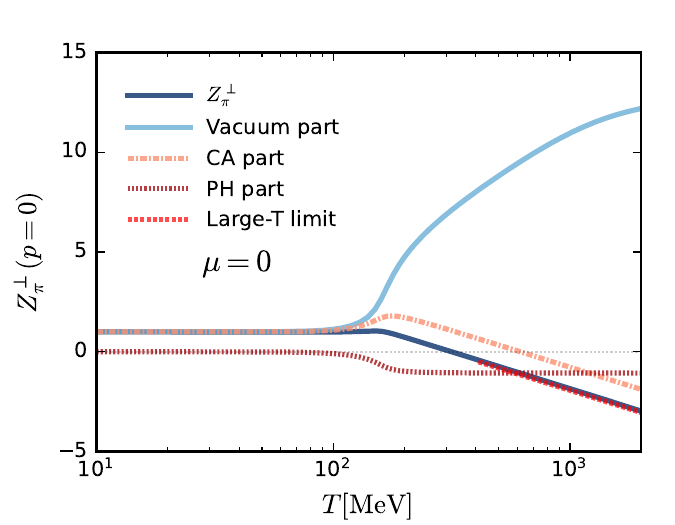
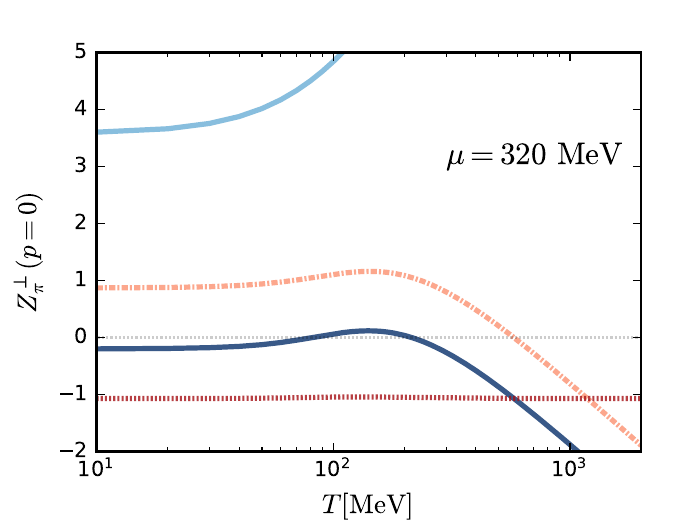
Particle Creation and Annihilation (C.A.)
\[
\begin{aligned}
\frac{-1+n_F(E_q(q);T,\pm\mu)+n_F(E_q(q-p);T,\mp\mu)}{E_q(q)+E_q(q-p)}
\end{aligned}
\]
Particle-Hole fluctuation (P.H.) / Landau damping
\[
\begin{aligned}
\frac{n_F(E_q(q);T,\pm\mu)-n_F(E_q(q-p);T,\pm\mu)}{E_q(q)-E_q(q-p)}
\end{aligned}
\]
Dirac cone
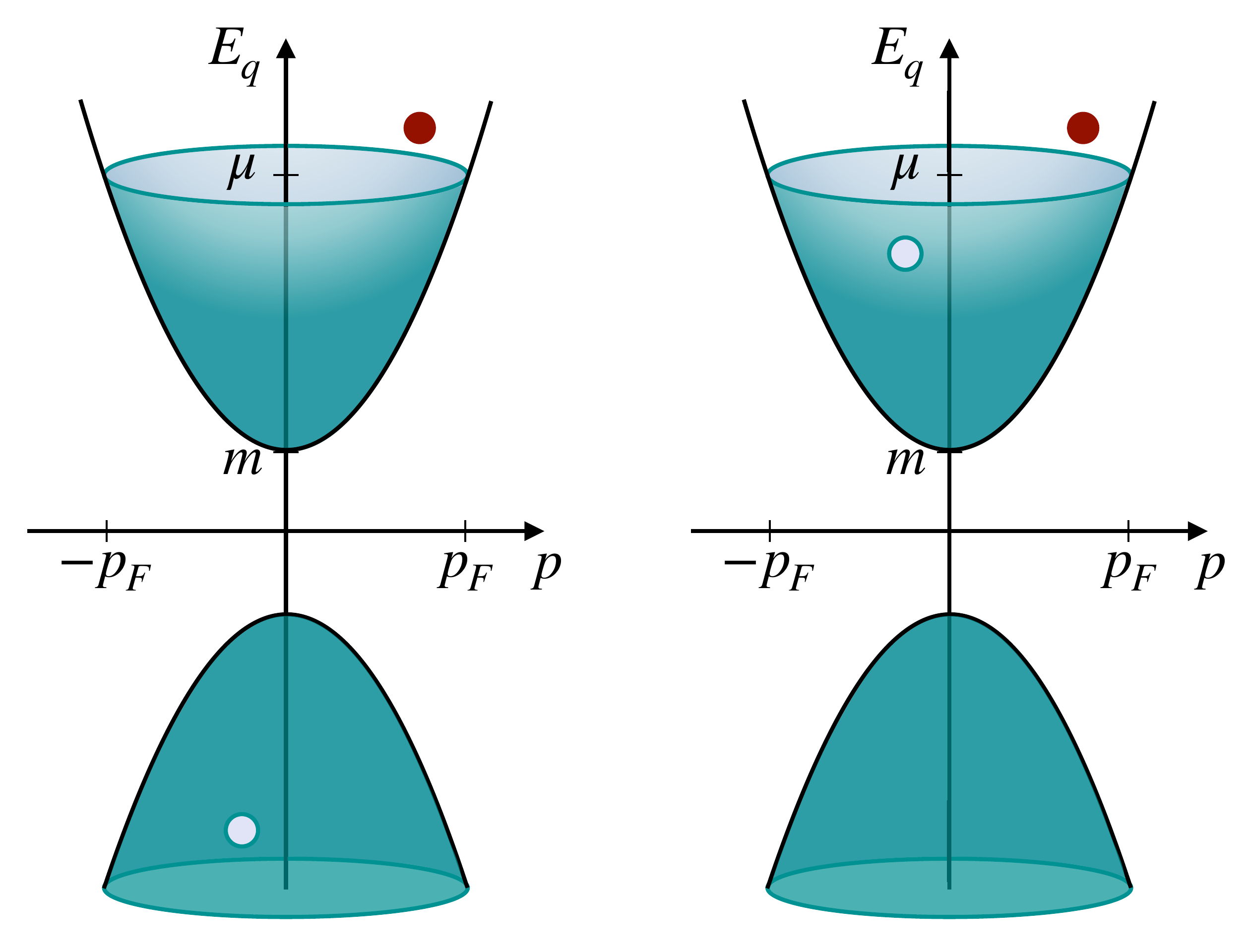
C.A.
P.H.
C.A.
P.H.
Screening effect!
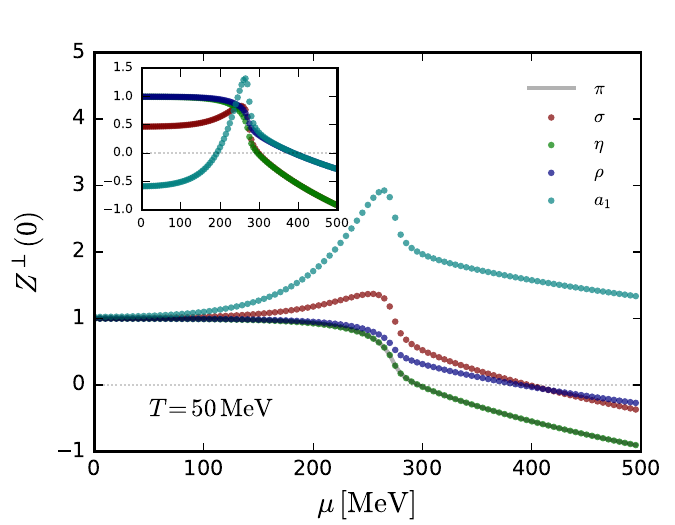
Moat regime of other mesons
Quark-Meson interaction of heavier mesons
\[
\begin{aligned}
&\sigma \sim h_\sigma\,\bar{q}\,T^0\,\sigma\, q\\[2ex]
&\eta \sim h_\eta\,\bar{q}\,T^0\,i\gamma_5 \eta\, q\\[2ex]
&\rho \sim h_\rho\,\bar{q}\,\bold{T}\,\gamma_\mu\rho^\mu\, q\\[2ex]
&a_1 \sim h_{a_1}\,\bar{q}\,\bold{T}\,i\gamma_\mu\gamma_5\,a_1^\mu\, q
\end{aligned}
\]
All tend towards a moat regime due to the similar structure of self-energy
Outline
- Moat regime on the QCD phase diagram
- Mechanism of the moat regime
- Connection to experimental observables
- Summary and Outlook
Possible Observables
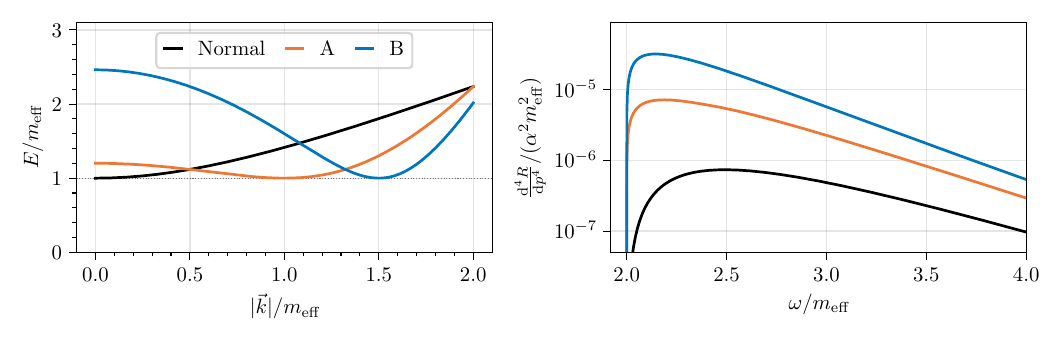
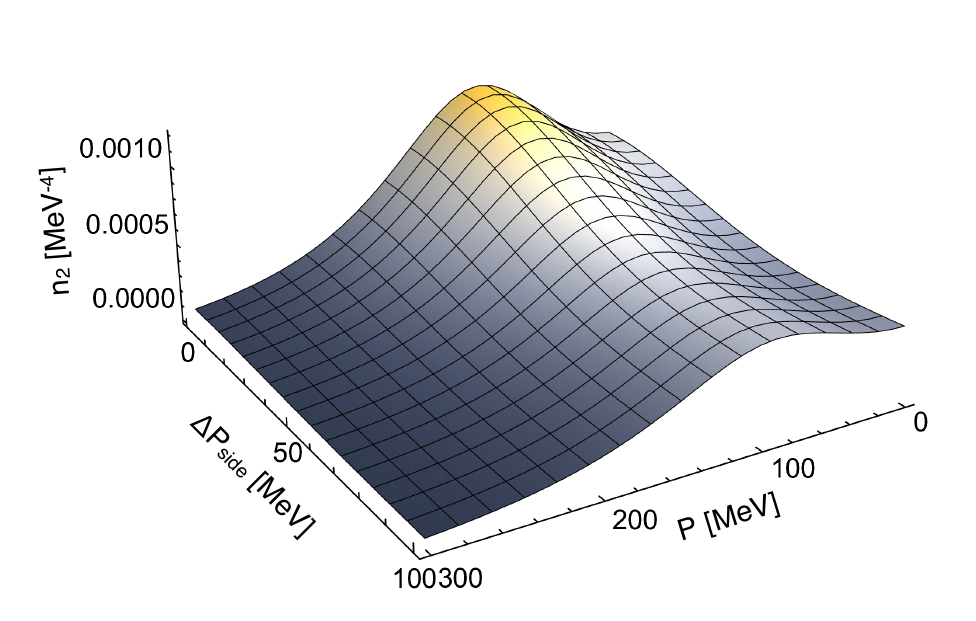
HBT interferometry
Peak
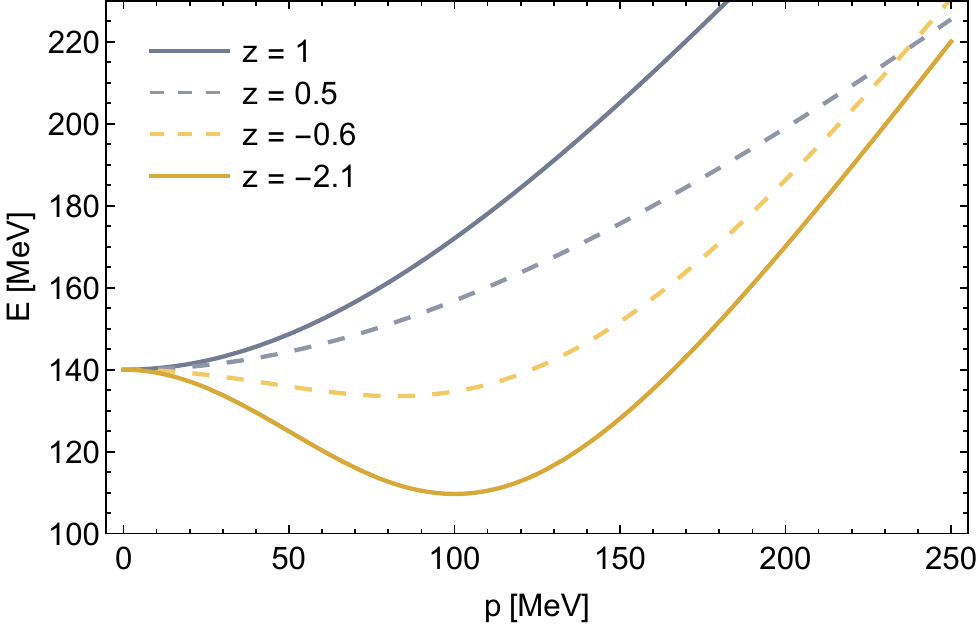
\[
\rho_\pi(\omega,\bold{p}) \sim \delta(\omega-E_{\mathrm{moat}})
\]
Time-like behavior of the spectral function
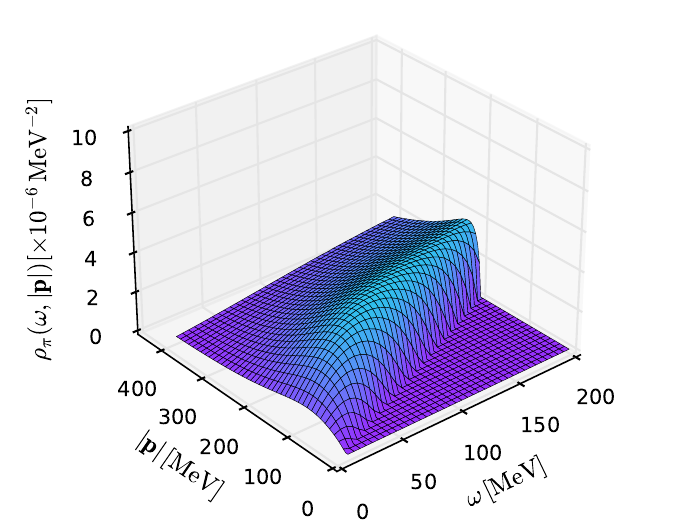
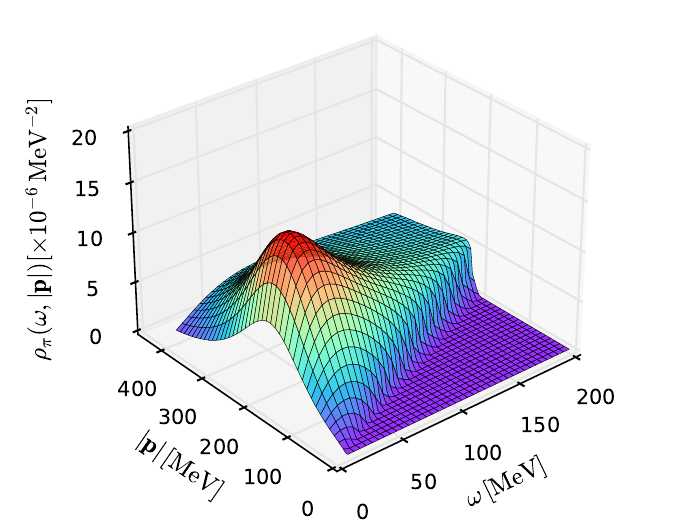
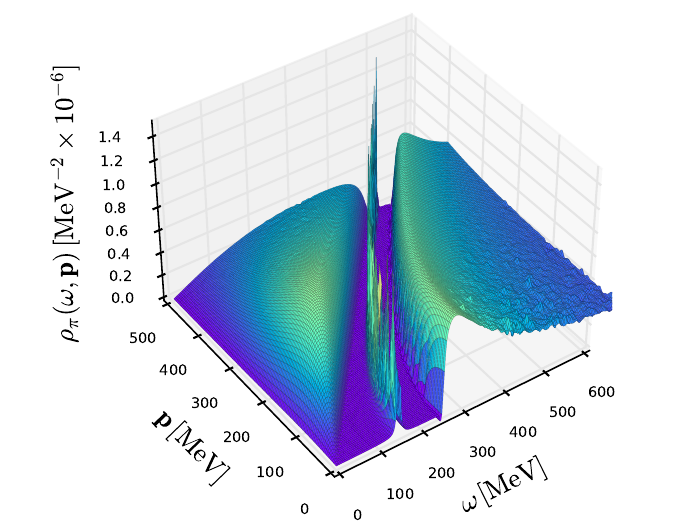
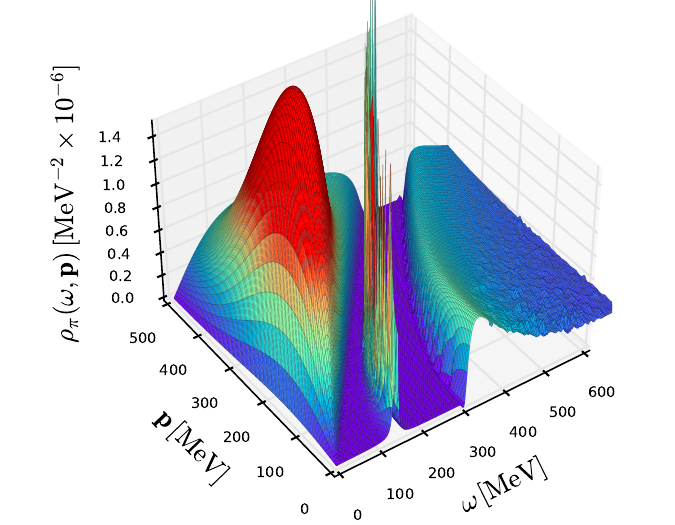
Spectral function of Pion
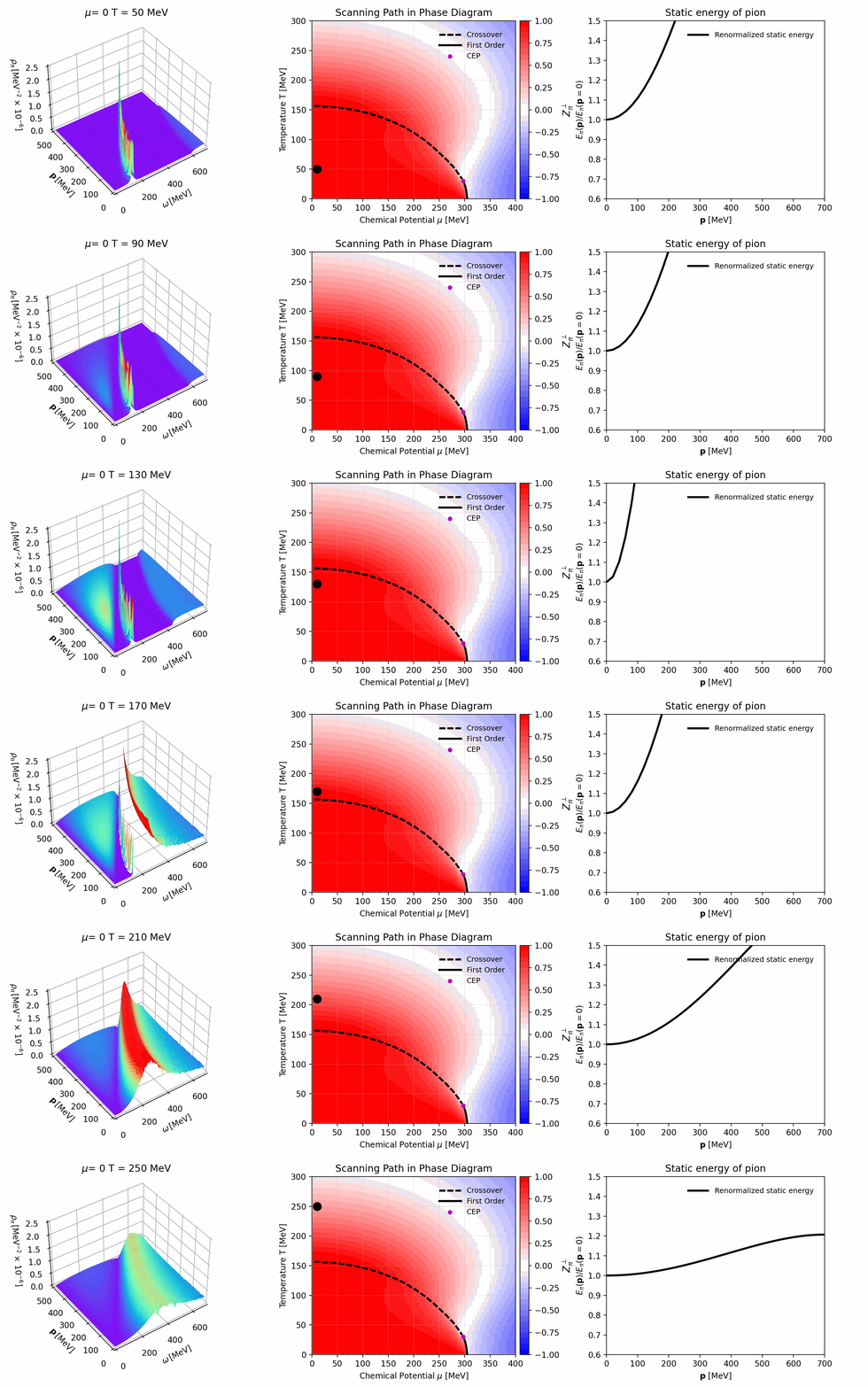
Spectral function of Pion from fRG-QCD
Space-like Peak
Outline
- Moat regime on the QCD phase diagram
- Mechanism of the moat regime
- Connection to experimental observables
- Summary and Outlook
Summary and Outlook
- The properties of the moat regime are investigated in a Quark-Meson model
- C.A. and P.H. fluctuations in the self-energy are identified as the driving mechanisms for the moat regime.
- Our findings suggest that the moat regime could extend to heavier mesonic sectors.
- The space-like peak of the pion spectral function (both model and QCD results) are enhanced by moat and it may affect the heavy ion observables.
- HBT interferometry and dilepton production rate will be computed in the moat regime.
Back up: Spectral function of Pion
QM model results
\[
T = 155 \,\mathrm{MeV} \,\,\mu=0
\]
\[
T = 50 \,\mathrm{MeV} \,\,\mu= 280 \,\mathrm{MeV}
\]
fRG-QCD results
\[
T = 160 \,\mathrm{MeV} \,\,\mu=0
\]
\[
T = 114 \,\mathrm{MeV} \,\,\mu= 210 \,\mathrm{MeV}
\]
Back up: C.A. & P.H. fluctuations
Back up: fluctuations of Yukawa coupling
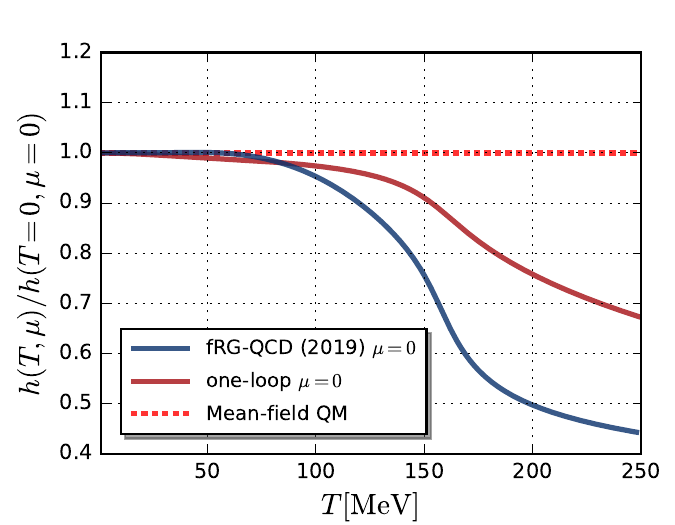
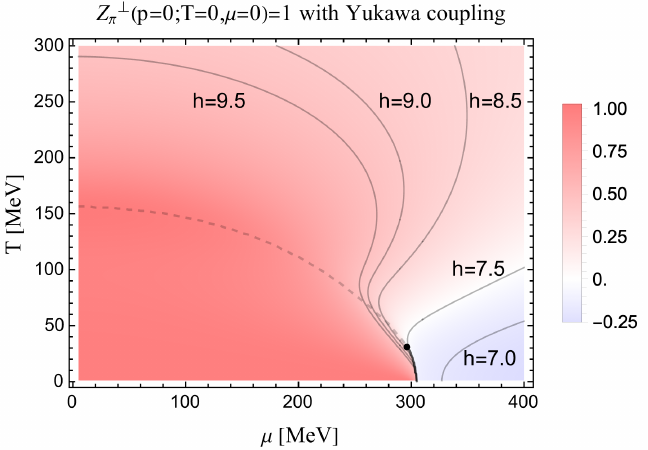
Yukawa coupling at finite T
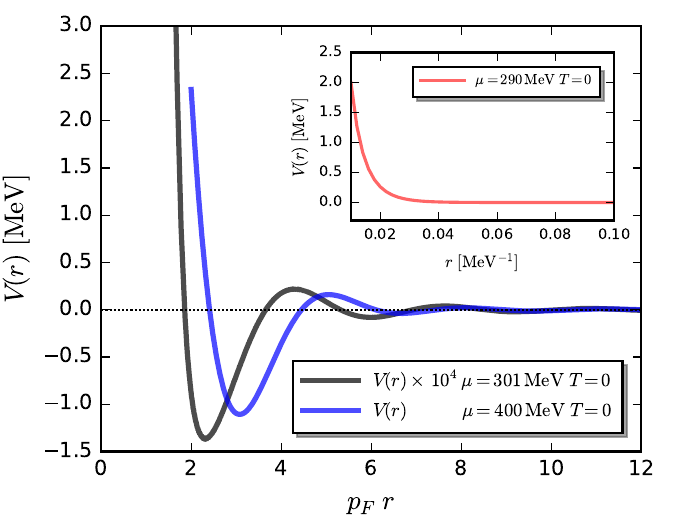
Back up: Friedel oscillations vs moat pole
\[
\begin{aligned}
V(r)=\frac{h^2}{2\pi^2r}\int^\infty_0dp\,\frac{p\,\mathrm{sin}(p\,r)}{\Sigma_\phi(p)}
\end{aligned}
\]
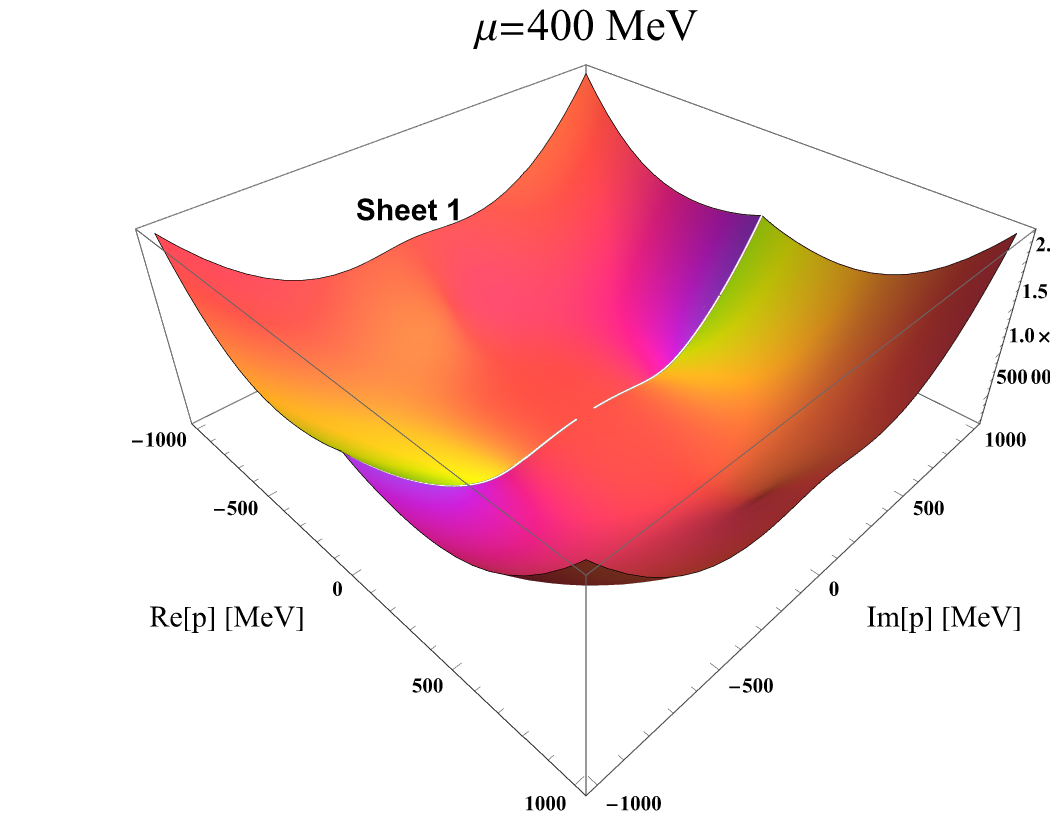
Principle Riemann sheet
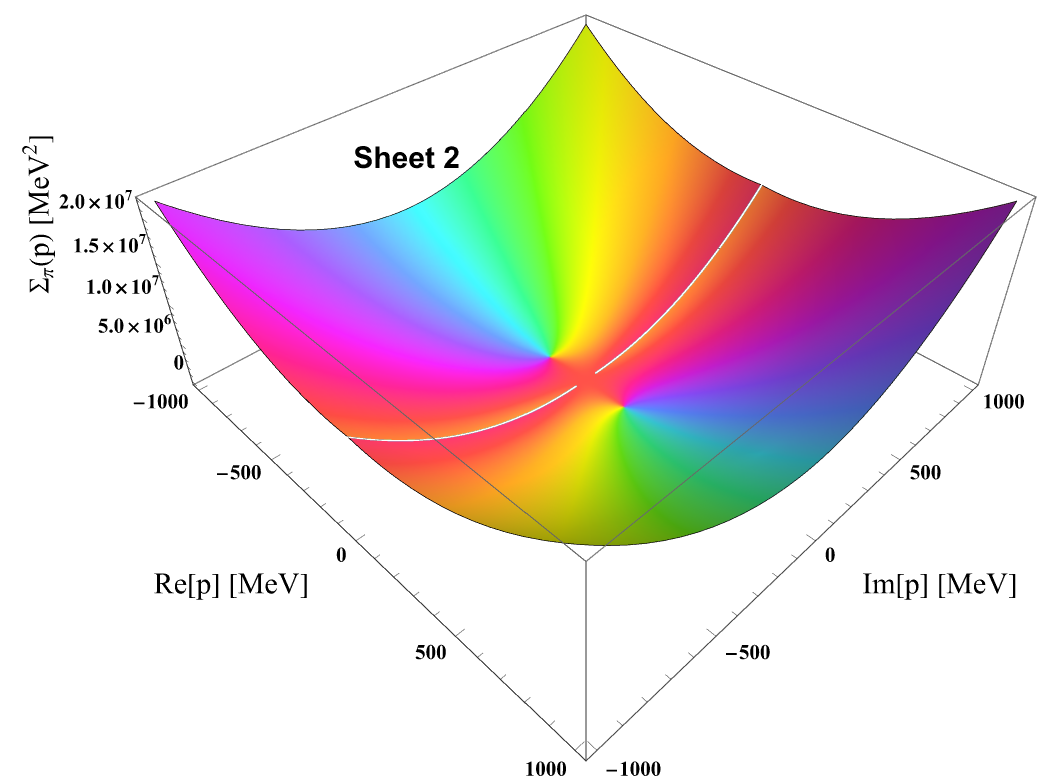
Second Riemann sheet